
Published: 2026-06-29
During the construction of the Chengdu–Deyang suburban railway (referred to as the Chengde Line, or S11 Line), Shanghai MRDCom Co., Ltd. has been deeply involved in building a highly reliable, highly redundant Integrated Supervisory Control System (ISCS) network foundation for this north–south backbone line spanning the Chengdu metropolitan area. As a key component of the "2 Rings, 3 Radiating Lines" rail transit backbone network for the Chengdu–Deyang–Meishan–Ziyang integration, the Chengde Line imposes extremely high demands on its underlying industrial communication network. Leveraging its deep technical expertise and extensive project experience in the rail transit sector, MRD industrial switches provide solid support for critical systems including the ISCS, Access Control System (ACS), and Building Automation System (BAS) on the Chengde Line, serving as a vital technical safeguard for this “half‑hour commuter” artery connecting Chengdu and Deyang.
I. Project Background
.jpg)
The Chengde Line is the third suburban railway in the Chengdu metropolitan area and a key "radiating line" within the "2 Rings, 3 Radiating Lines" rail transit backbone network for the Chengdu–Deyang–Meishan–Ziyang integration. The line starts at Weijianian Station of Chengdu Metro Line 1 and ends at Deyang North Station, passing through Jinniu District, Xindu District, and Pengzhou City of Chengdu, as well as Guanghan City and Jingyang District of Deyang. The total length is approximately 70.87 km, with 15 stations in total – 10 underground and 5 elevated. The total project investment is approximately RMB 30.5 billion, and the line is expected to enter trial operation in 2027.
As a vital link promoting integrated development between Chengdu and Deyang, the Chengde Line will enable a "half‑hour commuter"connection between the two cities upon completion. Passengers will be able to seamlessly transfer to Metro Lines 1, 5, and others within Chengdu, and connect southward to Line 18 to reach Tianfu International Airport, as well as link to the Chengzi and Chengmei lines to reach Ziyang and Meishan. Such a high‑standard suburban railway – combining cross‑city commuting and regional connectivity – imposes comprehensive and stringent requirements on the industrial communication network of its ISCS: the backbone network must support 10‑Gigabit transmission capacity with carrier‑class reliability; the station‑level network must achieve accurate, real‑time, and secure communication in complex electromagnetic environments; and the entire system must incorporate robust redundancy mechanisms and fault isolation capabilities.
II. MRD Solution
As a leading enterprise in the industrial communication sector, MRD has been deeply involved in the network construction of the Chengde Line's ISCS. The company's proprietary MRD industrial Ethernet switches have been widely deployed in over 30 rail transit lines across cities including Shanghai, Beijing, Nanjing, Wuhan, and Tianjin, with products proven through long‑term field operation.
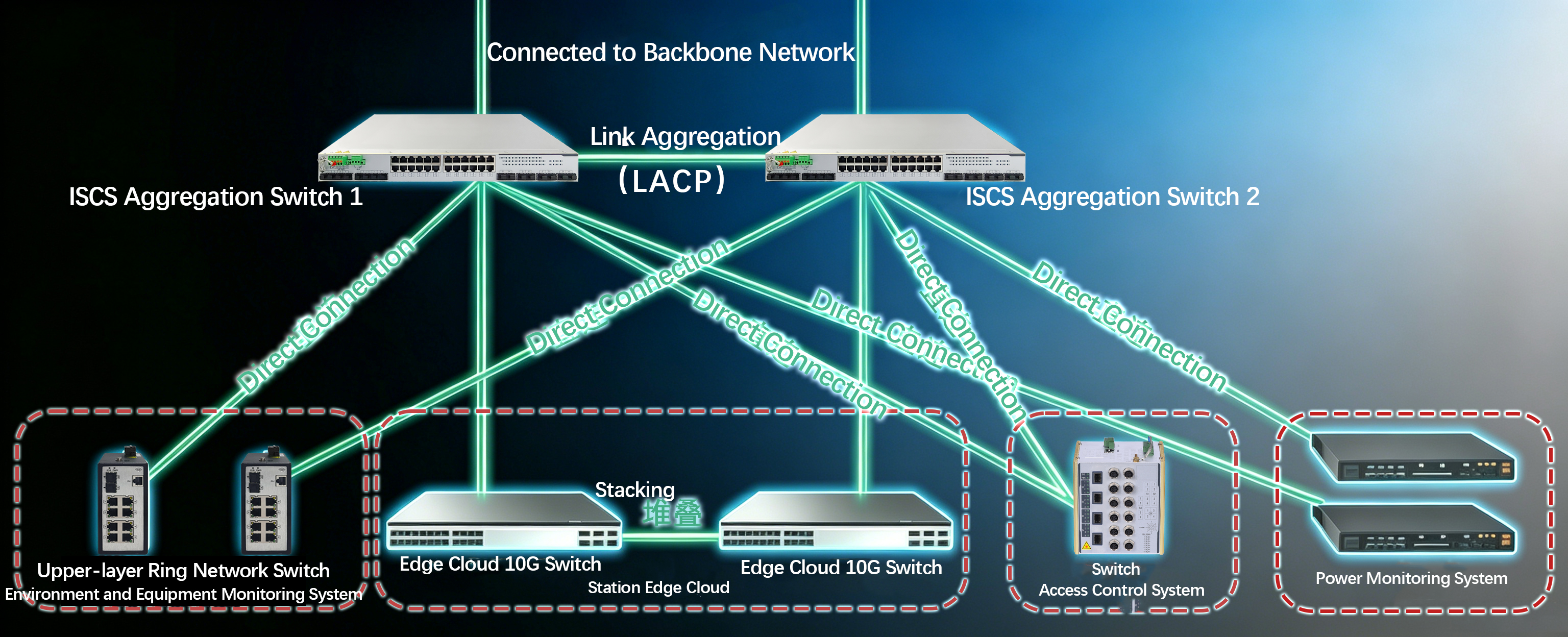
The ISCS of the Chengde Line adopts an active‑standby redundant, hierarchical, distributed C/S architecture, consisting of three network layers: the backbone layer, local area layer, and field layer. MRD provides a full range of industrial switch products – from core backbone to station LAN – for this architecture, building an independently controllable communication system centered on “domestic production, high performance, and high reliability.”
Backbone Layer: 10‑Gigabit Redundancy Supporting High‑Speed Data Aggregation Across the Line
The ISCS backbone network interconnects the LANs of all stations, the depot, and the control center along the entire line. Each station, the depot, and the control center serve as backbone nodes, each equipped with active‑standby redundant 10‑Gigabit Ethernet Layer 3 switches – namely the MRD TNM4000 series general‑purpose rack‑mount industrial switches. The main ISCS equipment at each node is connected to the local switch for data communication. Through the 10‑Gigabit optical ports configured on the local industrial switches, using the transmission channels provided by the communication system, the entire ISCS backbone network (MBN) is formed, linking the control center, all stations, and the depot into a complete large‑scale network‑based computer monitoring system.
The core challenge of the backbone network is that any backbone link failure would result in loss of monitoring data from multiple stations across the line, directly jeopardizing operational safety. The MRD TNM4000 series switches feature a fully redundant architecture, with Link Aggregation Control Protocol (LACP) adopted for inter‑switch connections, effectively increasing link bandwidth while providing link‑level redundancy protection – a single link failure does not affect data transmission. The devices support ring network redundancy protection with self‑healing time of less than 50 ms, and backplane bandwidth up to 68 Gbps, delivering wire‑speed non‑blocking forwarding and ultra‑low latency, providing a stable, high‑speed data backbone for intelligent operations across the line.
Local Area Layer: Redundant Dual‑Star Architecture Ensuring Precise In‑Station System Coordination
At the station‑level LAN, the ISCS system at each station and the depot/parking lot ISCS system adopt a 1000M redundant dual‑star LAN architecture, compliant with IEEE 802.3 and using the TCP/IP protocol. Gigabit industrial Ethernet switches are deployed at the station level, connecting to the backbone network via 1000M optical ports on the transmission system equipment. Various integrated and interconnected subsystems access the station‑level ISCS through the station aggregation switch's 1000M Ethernet ports or firewalls.
In the specific deployment, the ISCS is equipped with MRD TNM4000 general‑purpose rack‑mount industrial switches as backbone nodes, with two edge‑cloud 10‑Gigabit Layer 3 switches connected downstream. These edge‑cloud switches are deployed in a dual‑redundant stack configuration, providing both device‑level and link‑level redundancy protection.
The Access Control System (ACS) uses a single MRD TCC4100 DIN‑rail industrial switch as the primary network device within the system, directly connected to the two aggregation switches respectively. The Spanning Tree Protocol (STP) is used to prevent network loops, ensuring normal network operation even in the event of a single link failure.
The Building Automation System (BAS) employs two MRD general‑purpose Layer 2 industrial switches (model TOM1000‑ISB10U2080) as upper‑layer ring switches, interconnected with the ISCS aggregation switches on a one‑to‑one basis, forming a dual‑ring redundant architecture. The BAS is responsible for critical functions such as environmental control and equipment monitoring across all stations. The ring architecture ensures that in the event of any node or link failure, the system can still maintain communication via alternative paths.
Network Security Isolation: Defence‑in‑Depth for a Trusted Communication Environment
In terms of network security for systems such as BAS, ACS, and PSCADA, MRD switches implement logical isolation and access control between systems through VLAN partitioning, Access Control Lists (ACL), and other technical measures, effectively preventing security risks from spreading across systems. The station edge cloud adopts 10‑Gigabit interconnection and stacking technologies, with STP enabled by default to prevent network loops, further enhancing network reliability and security.
MRD industrial switches are purpose‑built for rail transit applications, compliant with EN50155/50121 standards. The electrical ports use M12 rugged connectors, ensuring stable switch operation under vibration or shock conditions. The devices feature industrial‑grade protection including wide‑temperature operation, vibration resistance, and high EMC immunity, fully adapting to the complex physical environment where elevated and underground sections alternate along the suburban railway.
As the Chengde Line accelerates toward completion, the rail transit network of the Chengdu metropolitan area continues to expand. As a benchmark in the industrial communication industry, MRD will continue to empower the intelligent development of rail transit within the Chengdu–Deyang–Meishan–Ziyang integration through its independently controllable domestic technologies and full‑stack product portfolio. As a staunch force in domestic substitution, MRD will persistently deepen its core industrial communication technologies, providing stable and reliable communication support on an independent "foundation for the' rail‑based metropolitan area."
MRD Showcases TSN Switches at 2026 CIIF
How Does a 6.8 km Yangtze River Crossing Tunnel Achieve Zero Communication Interruption?
MRD Industrial Switches in Xinjiang Kalpin 400MW CSP Project
MRD Patriot All‑Domestic Series with Changzheng Software Powers Nanhui Branch Line
Hotline: 86-21-58330762
Zip: 201203
Email: sales@mrdcom.net
Address: No.123 Curie Road, China (Shanghai) Pilot Free Trade Zone




Copyright 2026 MRD Co LTD . All Rights Reserved Shanghai ICP No.12035199


