
Published: 2026-06-12
11New-Generation, Independently Controllable “Four-Unified” Power Switch – The “Chip” Engine for Power Digitalization
As the new-type power system is being comprehensively built and the “three-layer, two-network” architecture of smart substations becomes deeply prevalent, the IEC 61850 standard and the “Four Unifications, Four Specifications” mandated by State Grid Corporation of China (SGCC) and China Southern Power Grid (CSG) have become the core admission criteria for power communication equipment. Faced with the rigid requirements of high real-time performance, high reliability, and high security for process‑layer GOOSE/SV messages, MRD – the proprietary brand of Shanghai MRDCom Co., Ltd. – leverages its deep technical accumulation and extensive practical experience in the industrial interconnection field. With a hard‑core combination of domestically produced dedicated chips and an indigenous power‑grade operating system, it perfectly adapts to the three‑layer, two‑network substation architecture, providing full‑scenario support for process‑layer GOOSE/SV real‑time transmission and station‑layer stable control, thereby empowering the digital and autonomous upgrade of power grids.
Addressing Core Scenario Needs: What Exactly Makes the “Three‑Layer, Two‑Network” Smart Substation Challenging?
Under the three‑layer, two‑network architecture of a smart substation, process‑layer GOOSE/SV and station‑layer CMS/MMS messages impose extreme demands on the network:
Strict Real‑Time Performance: SV sampling and GOOSE tripping require microsecond‑level deterministic transmission with zero jitter and zero packet loss.
Extremely High Reliability: Under strong electromagnetic interference and wide temperature/humidity fluctuations, equipment must operate 7×24 hours uninterruptedly.
Mandatory Localization: Core hardware and software must be independently controllable to secure the power supply chain.
Standardization Compliance: Strict adherence to the “Four Unifications” specifications, with compatibility with existing systems and IEDs.
Security and Compliance: Full compliance with the overall protection framework for power monitoring systems – “security zoning, network dedicated, lateral isolation, longitudinal authentication” – supporting measurable, controllable, and auditable network operation across the entire domain.
MRD Meridian’s “Four‑Unified” smart substation switch uses the Centec E5216 dedicated power chip as its high‑performance hardware foundation, coupled with the 100% self‑developed, domestically produced Centauri operating system. With full‑stack independent control from chip to software, it provides a highly reliable communication solution for smart substations that meets both power industry and enterprise standards.
Hardware Foundation: E5216 Dedicated Chip – Tailor‑Made for Power Scenarios
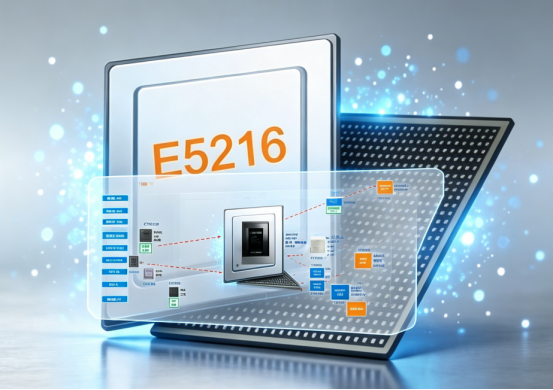
High‑Performance Hardware Base: Adopts Centec’s self‑developed E5216 power‑dedicated switching chip, providing native hardware capability support for highly reliable, low‑latency power communication. It integrates 16×10G SerDes + 2×10G Combo PCIe CPU management ports, with a core bandwidth of 160 Gbps/64B, fully covering high‑speed communication requirements across all scenarios of the three‑layer, two‑network architecture.
Low Power Consumption, High Reliability: Manufactured with pure domestic advanced processes, it offers lower overall power consumption and more stable operation, meeting the long‑term uninterrupted operation requirements of power equipment.
Power‑Grade Deep Adaptation: Hardware natively supports key features for power scenarios, providing the optimal operating environment for the Centauri OS.
Traffic Visibility and Security Compliance: Natively supports IPFIX (IP Flow Information Export), the international standard flow collection protocol, enabling accurate identification, fine‑grained statistics, and standardized output of service flows across the entire network. This supports traffic traceability, anomaly detection, capacity planning, and operation & maintenance auditing, achieving full‑dimensional visibility and manageability of the power communication network.
Native Security Architecture: Chip‑level built‑in security isolation and partitioned forwarding capabilities fully support the overarching security principles of “security zoning, network dedicated, lateral isolation, longitudinal authentication” for power monitoring systems. It enables hardware‑level boundary isolation between production control zones and management information zones, physical separation between service planes and management planes, and trusted authentication/encrypted protection for longitudinal communication links, building a solid security foundation from the hardware layer.
Centauri Operating System: Full‑Stack Indigenous, Power‑Grade Core Engine
1. Real‑Time Communication Capability – Native SV/GOOSE Hardware Acceleration
Centauri OS deeply adapts to the hardware features of the E5216 chip, natively implementing hardware‑accelerated scheduling for SV/GOOSE messages. This ensures microsecond‑level deterministic forwarding with zero jitter and zero packet loss, and significantly improves forwarding efficiency over general‑purpose system solutions, perfectly meeting the rigid real‑time communication requirements of the process layer.
2. Full Adaptation to CSG Scenarios – Precise Latency Metering & Intelligent Network Self‑Healing
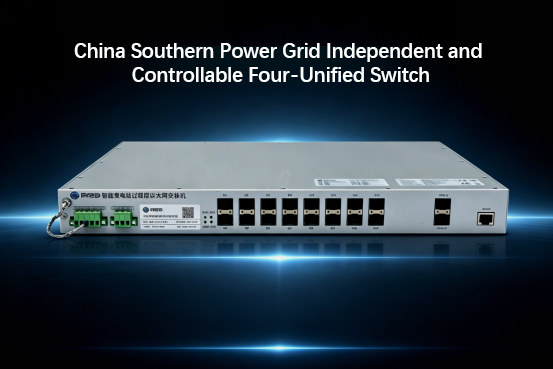
Precise Latency Accumulation: The Centauri OS provides hardware‑level end‑to‑end message latency accumulation, recording transmission delays in real time with millisecond accuracy, ensuring zero‑packet‑loss, low‑jitter stable communication, in full compliance with the high‑reliability communication standard Q/CSG 1203066‑2019.
Intelligent Routing Self‑Healing: The system embeds chip‑level dynamic routing algorithms that automatically sense network topology changes, achieving millisecond‑level link switching under fault conditions to ensure uninterrupted core services.
Unified and Convenient O&M: Centauri OS supports front/rear panel status visualization, intelligent alarming, unified management, and traffic control, fully adapting to China Southern Power Grid’s centralized monitoring and intelligent O&M management model.
3. Full Compliance with SGCC Scenarios – CMS Protocol, Physical Isolation, High‑Level Security
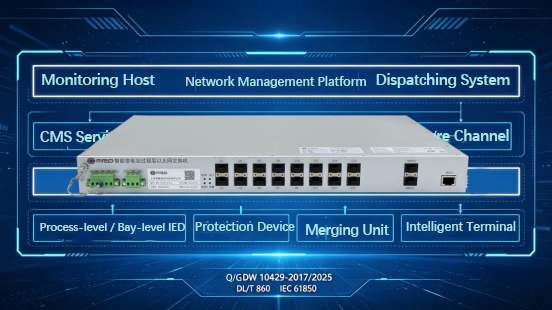
Native CMS/MMS Protocol Support: Provides dual‑port CMS/MMS protocol services, with physical isolation between CMS/MMS management ports and service ports, strictly meeting the mandatory requirements of “secure communication and physical isolation” for process‑layer switches as specified in SGCC standard Q/GDW 10429‑2025.
High‑Level Security Protection: The system follows the DL/T 860 (IEC 61850) standard for modeling and communication mechanisms, supporting message encryption, access control, and security auditing, effectively defending against cyberattacks and ensuring the security of power grid monitoring data transmission.
Architectural Synergy: Dedicated Chip × Centauri OS – A Powerful Combination
| Feature | General Domestic Chip | MRD (E5216 + Centauri) |
| Power Protocol Acceleration | No hardware‑level system coordination | Hardware acceleration for SV/GOOSE packets, forwarding efficiency improved by 30%+ |
| Traffic Visibility and Auditing | No standardized flow collection | Native support for IPFIX, enabling full‑network traffic to be measurable, traceable, and auditable |
| Security Protection Architecture | General perimeter protection | Chip‑level support for "security zones, dedicated networks, lateral isolation, vertical authentication", delivering defense‑in‑depth security |
| Power Consumption Control | General high power consumption | Pure domestic low‑power process, +Centauri intelligent power management, better overall power consumption |
| Reliability Level | General industrial grade | Power‑grade EMC Level 4, IP40 advanced protection design |
| Scenario Adaptability | General network scenarios | Deeply customized for substation three‑layer two‑network architecture, native adaptation for all scenarios |
Structural Design Advantages – Stable Operation in Extreme Environments
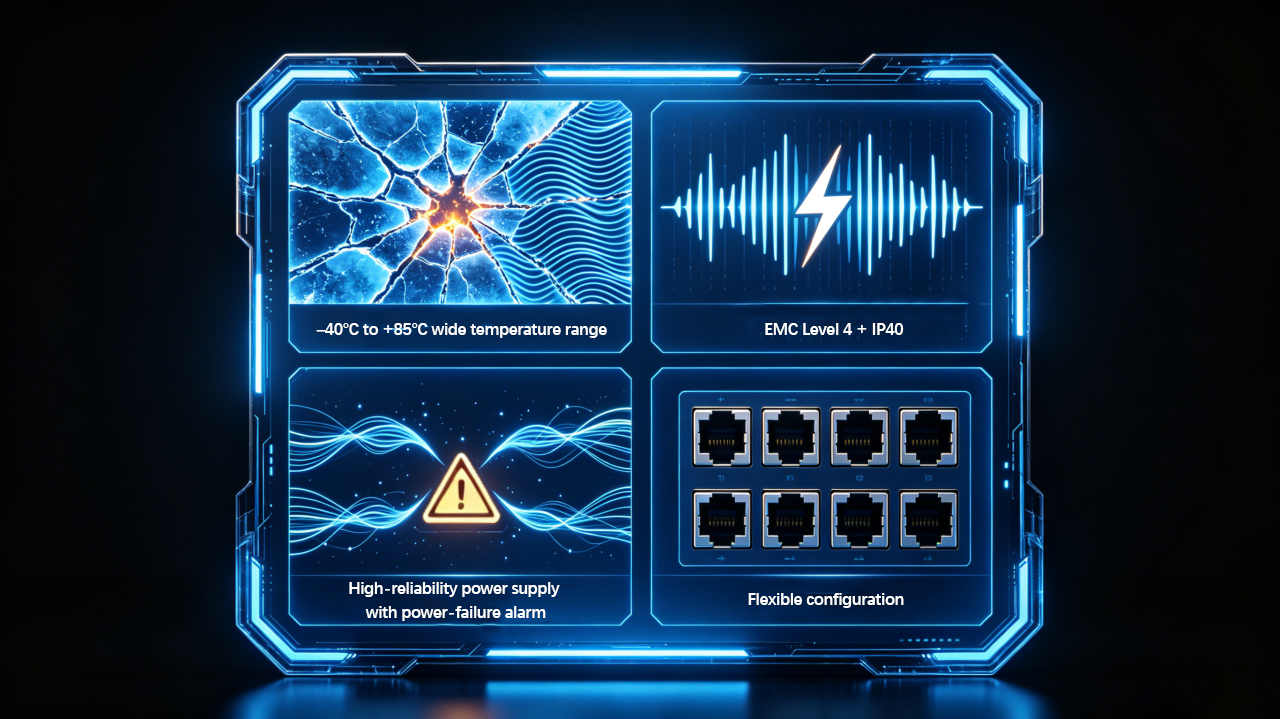
Ultra‑Wide Temperature Range: Operating temperature from –40°C to +85°C, stably adapting to extreme environments such as outdoor, basements, and high altitudes.
Strong EMC Compatibility: Meets EMC Level 4 and IP40 protection rating, with immunity to interference, lightning strikes, and radiation from high‑voltage equipment.
Highly Reliable Power Supply: Dual 100–240 V AC/DC self‑adaptive inputs, with power‑fail alarm support, unaffected by grid fluctuations.
Flexible Modular Configuration: Supports combinations such as 24 electrical + 4 optical, 16 optical + 4 optical, etc., allowing on‑demand selection to suit substation networking needs at different voltage levels.
Value of Modular Design – Efficient Deployment & Full‑Lifecycle Quality and Efficiency Improvement
Flexible Adaptation and Deployment: Modular hardware architecture + Centauri OS intelligent configuration makes network solutions more aligned with actual site requirements, enabling more efficient deployment.
Intelligent O&M Simplification: Centauri OS integrates intelligent alarming, auto‑configuration, and unified O&M capabilities, greatly simplifying on‑site inspections and fault diagnosis, and improving equipment availability.
Long‑Term Stable Operation: Low‑power hardware + high‑reliability system co‑work to effectively extend equipment service life, making long‑term operation more worry‑free.
Centauri Operating System – Core Capabilities Overview
Fully Indigenous and Self‑Controlled Kernel: Self‑developed based on Linux / Power Harmony OS, 100% localized with no external dependencies, certified for independent‑control maturity – secure, trustworthy, manageable, and controllable.
Power‑Grade Deep Optimization: Tailored for high real‑time, high reliability, and high security requirements, with hard real‑time scheduling and highly stable operation, far outperforming general‑purpose operating systems.
Intelligent Collaborative O&M: Supports remote configuration, firmware upgrades, log auditing, and status monitoring, providing standardized northbound interfaces for seamless integration into the unified grid network management platform.
Full‑Protocol Stack: Centauri OS natively supports power protocols including IEC 61850, CMS, MMS, GOOSE, SV, 1588v2, etc., enabling plug‑and‑play interoperability across multi‑vendor devices.
SGCC High‑Reliability Protocol: Centauri OS Perfectly Adapts to Q/GDW 10429‑2025
| Q/CDW10429-2025 Specification Requirements | Corresponding Capabilities of MRD Meridian Intelligent Substation Four‑Unified Switch |
| High‑reliability communication at process level | SV/GOOSE hardware acceleration, zero packet loss, low latency |
| Physical port isolation | Physical isolation between MMS port and service ports |
| Electromagnetic compatibility (EMC) protection | EMC Level 4, IP40 protection |
| Wide‑temperature environment adaptability | Stable operation from –40°C to +85°C |
| Redundant power supply guarantee | Dual power supply + power‑failure alarm |
| Network security and observability | IPFIX flow collection + chip‑level security partitioning, meeting security compliance requirements |
Authoritative Compliance Certification – Full Compliance with Triple Standards
The Centauri OS and the overall switch solution fully comply with seven key power industry authoritative specifications:
DL/T 2336‑2021 – Cybersecurity Testing Requirements for Electric Power Monitoring System Equipment and Software
DL/T 2337‑2021 – Cybersecurity Technical Requirements for Electric Power Monitoring System Equipment and Software
DL/T 1241‑2024 – Technical Specifications for Industrial Ethernet Switches in Electric Power Systems
Q/CSG 1203065‑2020 – General Application Model for IEC 61850 Engineering in Substations
Q/CSG 1203066‑2019 – Technical Specifications for Process‑Layer Ethernet Switches in Substations
Q/CSG 1203065‑2020 – General Application Model for IEC 61850 Engineering in Substations (repeated in original – retained)
Q/CSG 1203066‑2019 – Technical Specifications for Process‑Layer Ethernet Switches in Substations (repeated in original – retained)
The equipment has passed the full‑item tests of the Electric Power Research Institute – safe, reliable, and compliant, ready for direct grid access.
Dual‑Network Compliance Adaptability – One Platform, Full Coverage for SGCC & CSG
.png)
Dual‑Protocol System Support: Centauri OS incorporates built‑in dual‑network compliance capabilities, enabling a single hardware platform to simultaneously meet both SGCC and CSG technical specifications.
Future‑Ready Scalability: Supports next‑generation technologies such as TSN (Time‑Sensitive Networking) and IPv6, smoothly adapting to the long‑term digital and intelligent evolution of power grids.
MRD Meridian’s new‑generation “Four‑Unified” power switch, powered by the Centec E5216 dedicated chip as its hardware foundation and the Centauri OS as its core brain, achieves deep hardware‑software synergy and full‑stack independent control. It natively supports IPFIX traffic visualization, fully meets the “security zoning, network dedicated, lateral isolation, longitudinal authentication” security protection requirements for power monitoring systems, and is dual‑network compliant, highly real‑time, and highly reliable. It is the preferred “chip” engine for the construction of three‑layer, two‑network smart substations, driving safe, autonomous, efficient, and intelligent grid upgrades.
MRD Showcases TSN Switches at 2026 CIIF
How Does a 6.8 km Yangtze River Crossing Tunnel Achieve Zero Communication Interruption?
MRD Industrial Switches in Xinjiang Kalpin 400MW CSP Project
MRD Patriot All‑Domestic Series with Changzheng Software Powers Nanhui Branch Line
Hotline: 86-21-58330762
Zip: 201203
Email: sales@mrdcom.net
Address: No.123 Curie Road, China (Shanghai) Pilot Free Trade Zone




Copyright 2026 MRD Co LTD . All Rights Reserved Shanghai ICP No.12035199


