MRD delivers high‑reliability, high‑bandwidth, and cost‑effective communication transmission solutions for the rail transit Information Service Distribution System (ISDS) backbone network. With a deep understanding of the industry’s core requirements for security, reliability, guaranteed bandwidth, and scalability – and backed by years of research into service traffic patterns – we propose an innovative dual‑network architecture: a “voice and low‑speed data network” alongside a “broadband data network.”
As rail communications backbones evolve, bandwidth surge and unbalanced traffic mix create common pain points:
Bandwidth demand continues to rise
The business bandwidth of each subsystem continues to increase, and the transmission system is forced to adopt 10Gbps level bandwidth.The proportion of Ethernet services is too high
The required bandwidth is 80% and for Ethernet services, but for 20% of non-Ethernet services, 100% 10g is assumed for this, and the use of backbone bandwidth is unreasonable.Operation and maintenance system fragmentation
Traditional MSTP/SDH and hanging switches belong to different equipment systems. Maintenance requires professional transfer personnel, which is integrated into this high.High safety protection pressure
As a for subsystem convergence point, the transmission backbone network faces three major security challenges: network structure, system vulnerabilities, and protocol risks.
The voice/low‑speed data network and the broadband data network handle different traffic classes, each performing its designated role.
| plan | Technical route | bandwidth | Applicable business |
|---|---|---|---|
| Traditional/Mainstream Plan | SDH / MSTP / PTN / OTN | 2.5Gbps / 10Gbps | Mixed bearing of all services |
| MRD Recommended Solution | SDH/MSTP (Voice/Low Speed) + 10g Industrial Ethernet (Broadband Data) | 2.5Gbps + 10Gbps | Classification bearer, each division's position |
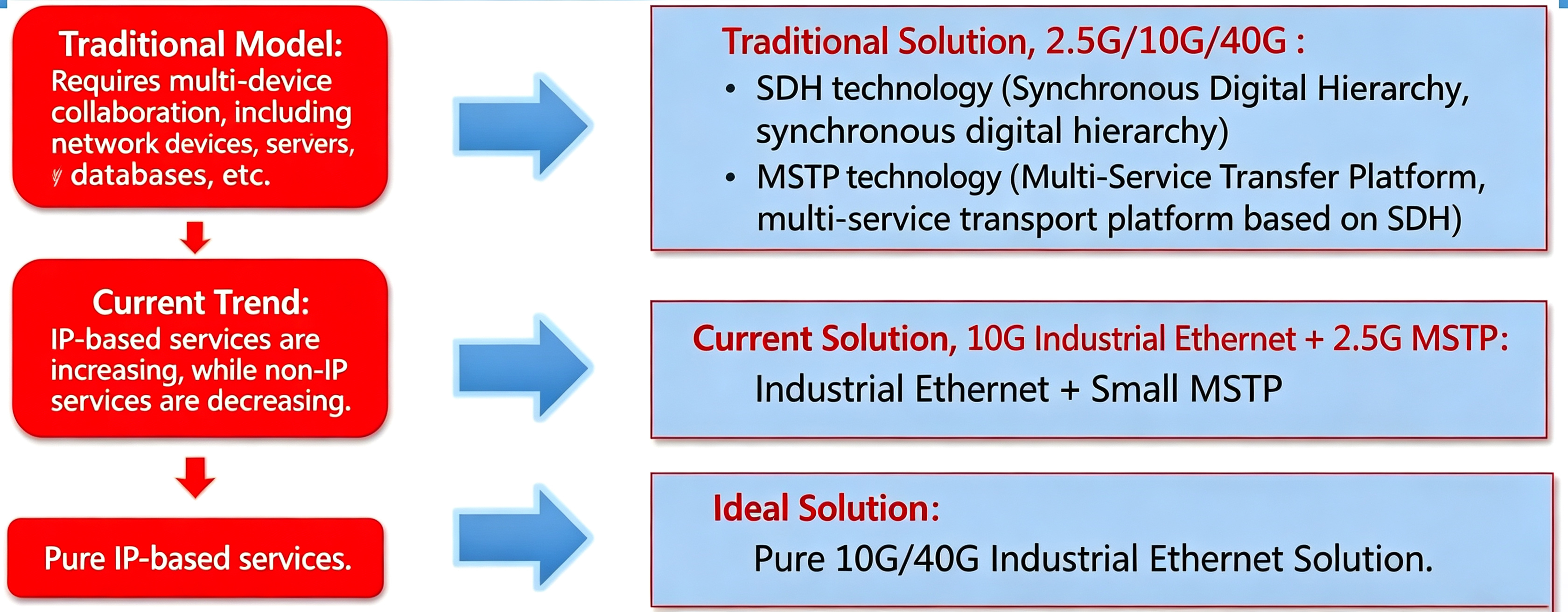
Our solution has provided for multiple lines to transmit backbone network design references, and the core product TNM6000 modular core industrial switch supports three-level security protection and HSR/PRP zero-loss redundant to meet the future all-IP trend.
The transmission backbone system task is to provide a unified network access platform for different business types. In addition to the signaling system, subsystems can rely on the transmission system achieves inter-site data communication:
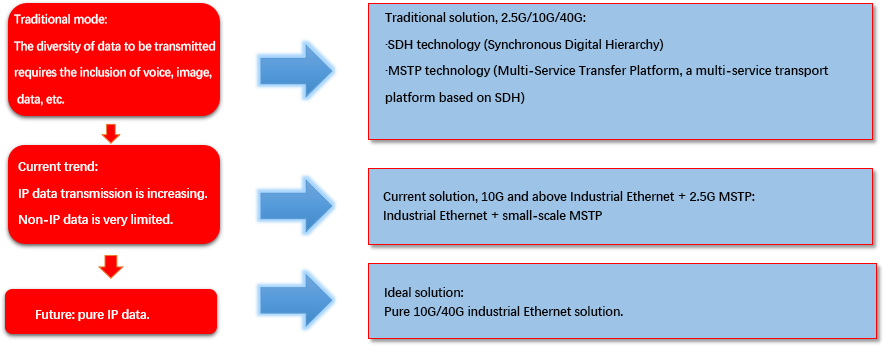
the evolution of the backbone network technology of the rail transit communication system has always been the primary consideration for security stability, bandwidth can guarantee, and scalability. The technical solution has evolved to:
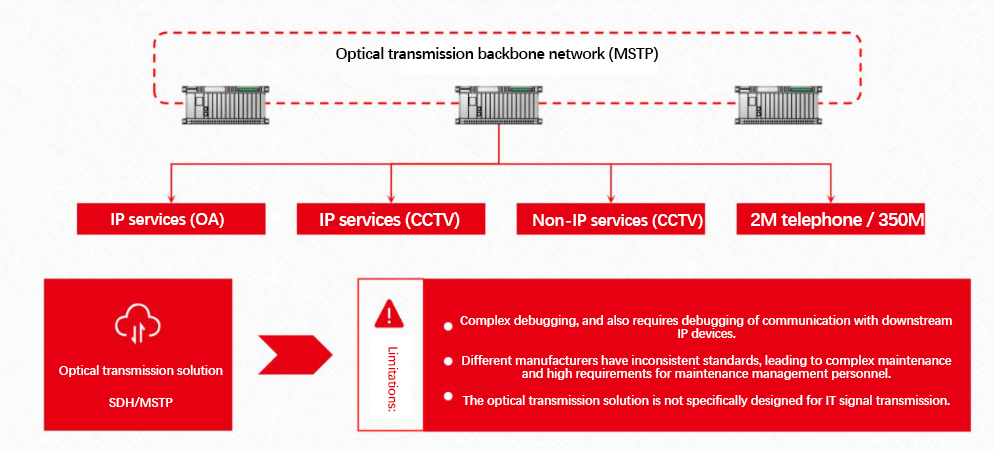
traditional solution
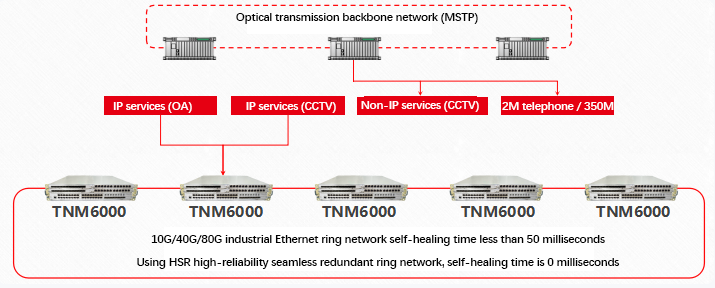 When the program
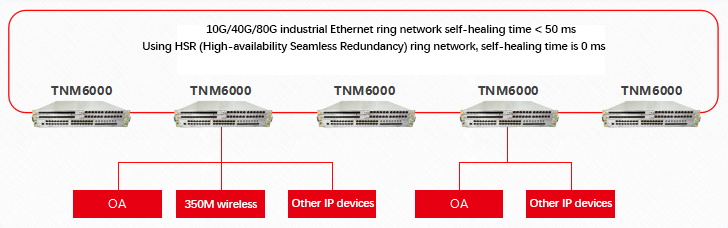 ideal solution
The business bandwidth requirements of each subsystem continue to increase, resulting in the transmission system having to adopt 10Gbps level bandwidth
The required bandwidth is 80% and for Ethernet services, resulting in unreasonable bandwidth usage of the for transmission backbone (for 20% non-Ethernet services, assuming 100% 10g for this)
Based on the in-depth study of the bandwidth types and bandwidth types of each service of the for communication system, MRD™ Meridian ® proposes two network solutions: "Voice and low-speed data network + broadband data network":
| network | Technical route | bandwidth | Bearing business |
|---|---|---|---|
| Voice and low-speed data networks | SDH/MSTP | 2.5Gbps | Narrowband services with extremely high voice, low-speed control signals, and real-world requirements |
| Broadband data network | 10GLayer-3Industrial Ethernet Switch | 10Gbps | CCTV, AFC, OA, etc. Ethernet services (80% traffic) |
More cost-effective: MSTP 2.5g + 10g Industrial Ethernet, lower than this for 10Gbps SDH/MSTP/PTN solutions
Stronger can management: Broadband data network adopts industrial Ethernet, and hung switches for the same type of equipment, unified management
More can scalability: IPstandard will not change, strong investment protection
| for Bidimension | 10g Industrial Ethernet Backbone | MSTP/SDH transport backbone |
|---|---|---|
| Purchase into this | Low | high |
| Maintain as this | Low-and-hanging switches are a class of equipment, and IT maintenance talents can be managed | High- and connected switches are two types of equipment and require professional transmission personnel (a failure point requires multi-professional personnel) |
| Device can Reliability | High — compliant with industrial standard, adaptable to various environments, long MTBF | Low — non-industrial standard, weak environmental adaptability, short MTBF |
| IP message transmission capability | high | Low |
| Non-IP message transmission capability | Low | high |
| Device types | Very many, mature technologies | Less (inconsistent for each manufacturer and each when period) |
| investment protection | Strong — IPstandard long-term stability | Weak — Fast device update, mixed devices in different when periods |
| Technology development trends | All-IP is the development trend in various industries | Unknown direction |
for Ethernet services account for the dominant (≥ 80%) rail-crossing transmission backbone network, the 10g industrial Ethernet bearer broadband data + SDH/MSTP bearer narrowband voice dual network solution is the optimal balance between technology, this, and operation and maintenance.
The transmission backbone network serves as a convergence point for all subsystems, and faces three major security challenges: network structure risk, system vulnerability risk, and protocol risk.
| Security risk category | Detailed description |
|---|---|
| Network structure risk | Complex structure, multiple subsystem interfaces, lack of regional isolation; lack of intrusion detection and security self-test mechanism; lack of data flow control and access audit between subsystems |
| System vulnerability risk | Transmission terminal equipment operating system vulnerability; country controller stored in after door risk |
| Network protocol risks | TCP/IP has inherent security flaws; industrial control protocols lack authentication/authorization/encryption; traditional IT firewalls cannot recognize industrial control protocols; anti-virus software affects system stability |
MRD provides can be embedded with the TNM6000 Core Switch Level 3 Security Module:
| protection hierarchy | Core functions | Technology achieves |
|---|---|---|
| Smart protection | Only allow specific format data passes; for all access data flows for control protection | Packet format, key bits, flow depth query and control |
| Audit testing | Illegal access monitoring; network for auditing | Real when detects abnormal access and records the entire network access log |
| Host protection | Deny viruses/Trojans; Deny unauthorized USB access; Deny unauthorized processes; Deny unauthorized network access | Terminal whitelist, USB port control |
| data isolation | One-way transmission characteristics to ensure that the packet has no one-way passes and no feedback; prevent important data leaks | One-way gatekeeper technology, data diode |
for Customer Value
in the transport backbone level, that is, achieves area isolation, intrusion detection, protocol filtering, one-way data transmission, etc. Warranty 2.0 for critical information infrastructure requirements.
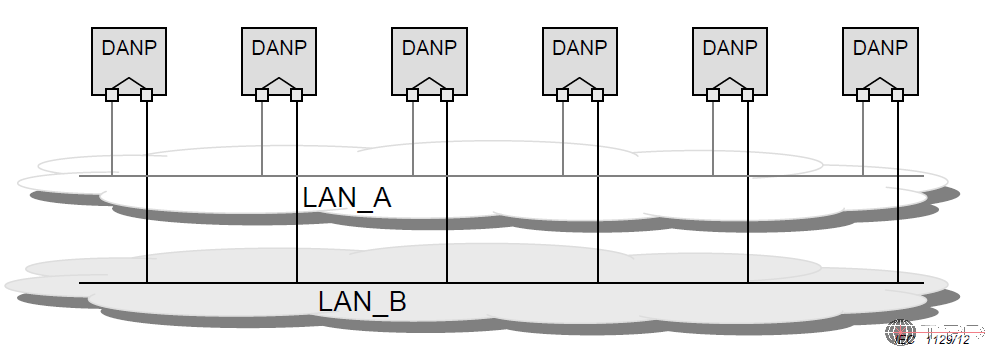
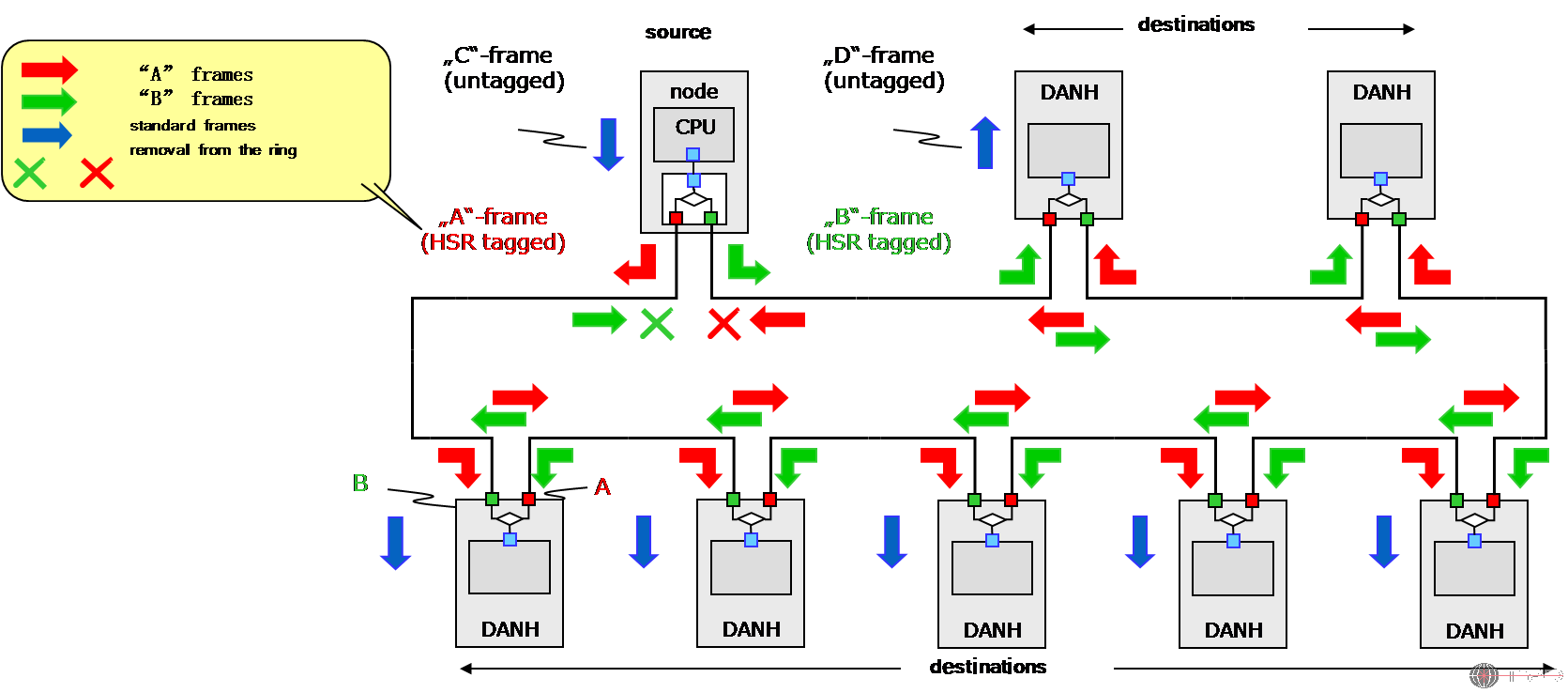
The International Electrotechnical Commission (IEC) defined the HSR (Highly Reliable Seamless Redundant) protocol in passes IEC62439-3-5 in 2012.
| protocol | standard | mechanism | performance |
|---|---|---|---|
| HSR | IEC62439-3-5 | Dual send and receive (same when sent in both directions along the loop, first to packet selected at the receiving end) | Zero packet loss, zero switching |
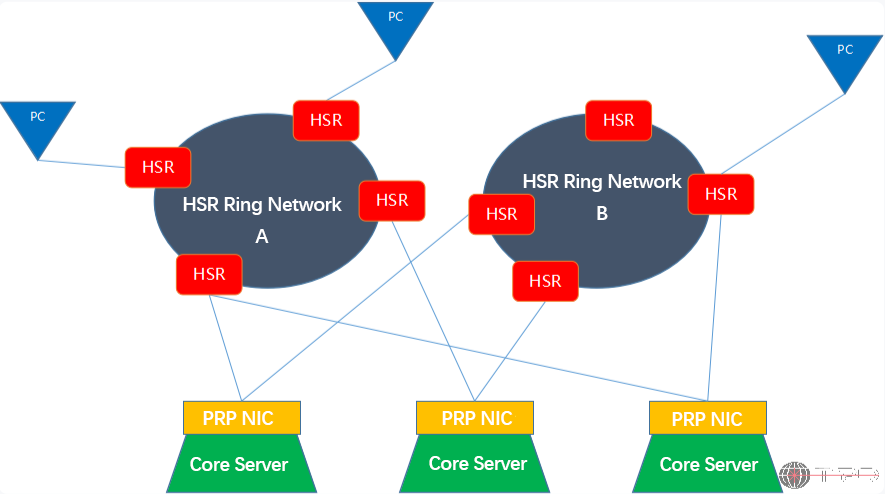
| PRP | IEC62439-3-4 | and row redundant (node is connected to A/B dual network, same IP/Mac, same send when) | Either of the two networks completely fails, with zero impact on business |
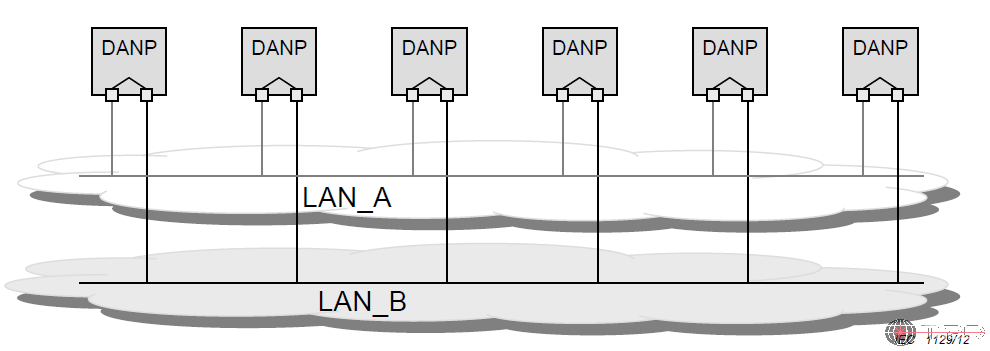
PRP and line redundant protocols
The backbone layer adopts HSR ring network (high bandwidth, zero switching)
The access layer adopts PRP (dual network isolation)
Further: The software achieves A/B network switching, sinks to the hardware layer to complete, releases CPU resources, and further shortens the interval between interruptions.
for Customer Value
the for fully automatic operation line (GoA3/4) provides transmission backbone layer zero break guarantee.
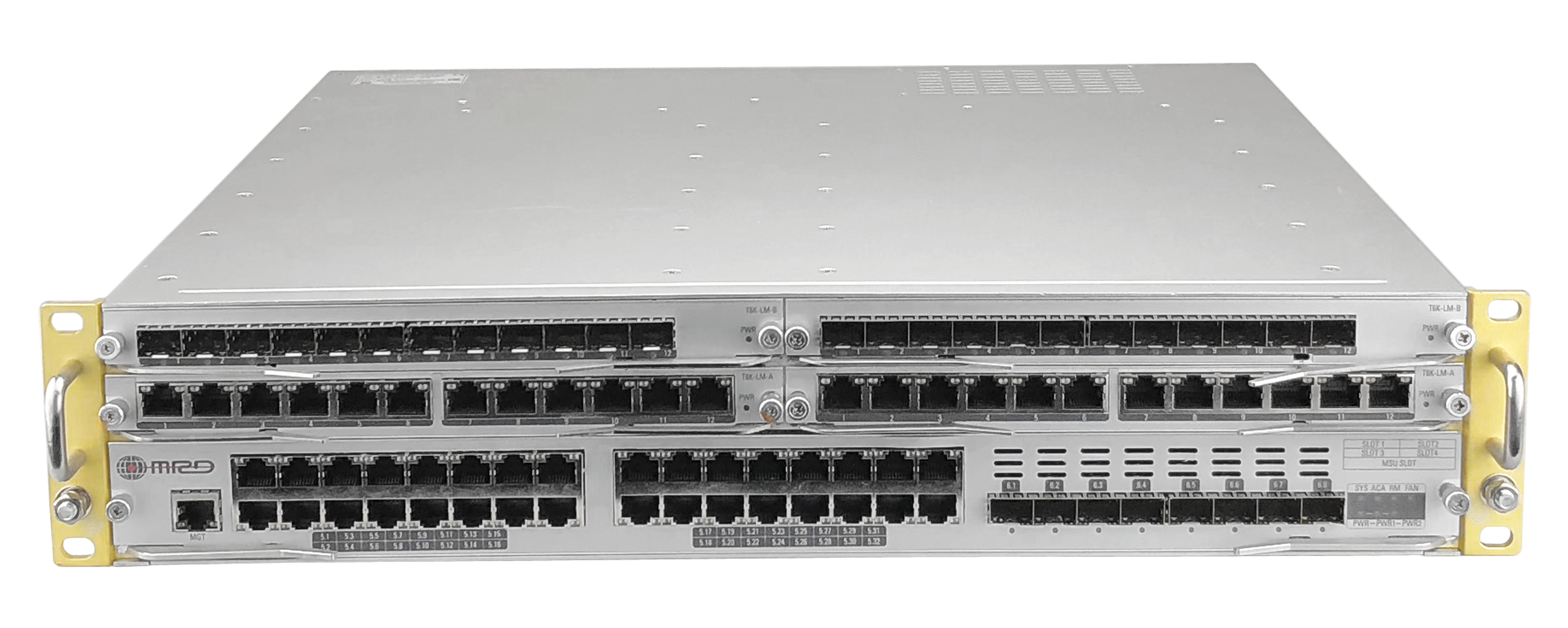
Up to 80 Gigabit + 8×10G ports; PoE IEEE 802.3af/at; any two ports can form self-healing rings with multiple independent rings; Layer-2 QoS rate limiting and traffic shaping for tiered Ethernet bandwidth services
More| Products | Critical capability | Sort | Descriptions |
|---|---|---|---|
| TNM6000 core industrial switch | Maximum support 80 Gigabit ports +8 10g ports can support PoE power supply, support IEEE 802.3af, 802.3atstandard can support any two... | eth-l3-mgt | See product details |
Every solution is built on relentless pursuit of product fundamentals. We disclose the following design details for the most demanding engineering review:

MTBF (Mean Time Between Failures)
Device-level stress prediction based on the SR-332 algorithm; system MTBF exceeds one million hours.
Service Life
Not only datasheet ratings—measured estimates based on electrolytic capacitor capacitance fade at minimum operating parameters @ operating temperature.
SDH/MSTP (2.5G) + 10G Industrial Ethernet

Industrial Ethernet outperforms SDH/MSTP carrying Ethernet traffic in CapEx, OpEx, reliability, and investment protection.

TNM6000 integrates three-level security and HSR/PRP zero-loss redundancy for MLPS 2.0 and FAO lines.

Industrial Ethernet aligns with all-IP trends; open standards with strong investment protection.
Hotline: 86-21-58330762
Zip: 201203
Email: sales@mrdcom.net
Address: No.123 Curie Road, China (Shanghai) Pilot Free Trade Zone




Copyright 2026 MRD Co LTD . All Rights Reserved Shanghai ICP No.12035199

2.5 Gbps bandwidth for voice, low-speed control and ultra-real-time narrowband services.
| for Bidimension | 10g Industrial Ethernet Backbone | MSTP/SDH transmission backbone network |
|---|---|---|
| Purchase into this | Low | high |
| Maintain as this | Low - and hung switches are a class of equipment, IT maintenance talent can be managed | High- and connected switches are two types of equipment that require professional transfer talents |
| Non-IP message transmission capability | Low | high |
| Applicable business | CCTV, AFC, OA, etc. Ethernet services (80% traffic) | Voice, low-speed control signals, narrowband services |
SDH/MSTP 2.5g bearers voice and low-speed data, and 10g industrial Ethernet classified bearers, each of its functions, avoiding for 20% non-Ethernet services to bear 100% 10g.
10 Gbps bandwidth for CCTV, AFC, OA and other Ethernet services (80%+ of traffic).
More cost-effective:MSTP 2.5g + 10g Industrial Ethernet, which is lower than the 10Gbps SDH/MSTP/PTN solution.
Stronger can manageability:Broadband data network adopts industrial Ethernet, and hung switches for the same type of equipment, unified management.
More can scalability:IPstandard does not change and investment protection is strong.
Based on IEC62439-3standard, HSR dual send and receive achieves zero packet loss zero switching, PRP dual network hardware level and line redundant. The backbone layer adopts HSR ring network, the access layer adopts PRP, and the for fully automatic operation line (GoA3/4) provides transmission backbone layer zero break guarantee. The core product TNM6000 modular core industrial switch supports three-level security protection and HSR/PRP zero-loss redundant.