
Published: 2026-09-07
The Passenger Information System (PIS) on metro trains serves as a critical window for passengers to access travel information and for operators to issue real‑time announcements. Any communication interruption or screen lag in the PIS directly impacts the passenger experience and may even disrupt operational dispatch. Therefore, the onboard communication network of the PIS must not only be stable and reliable, but also possess rapid self‑healing capability – during train operation, no single point of failure should affect information distribution across the entire train. In the onboard PIS upgrade project for existing lines of the Chengdu Metro, MRD industrial switches, with their robust ring‑network redundancy technology and onboard‑grade reliability, successfully supported the PIS upgrade, providing stable communication for core services such as display and broadcasting.
Project Background and Core Challenges
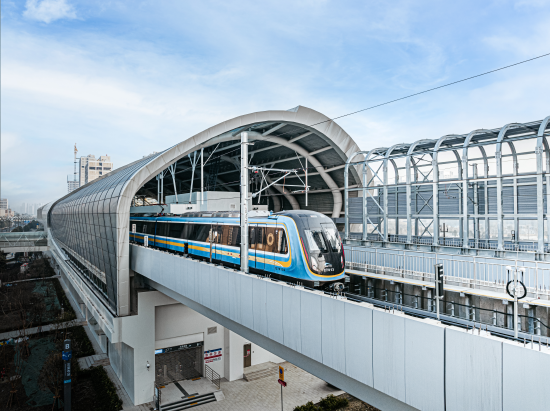
The existing lines of the Chengdu Metro have been in operation for many years, and the onboard PIS equipment has gradually entered its replacement cycle. In the original network architecture, each train was equipped with one onboard playback control server in each of the two cab ends. Adjacent to the cabs, one onboard bridge and one onboard industrial switch were installed in the passenger compartments, collectively forming the onboard network of the PIS. The existing onboard network had two core pain points: first, the network topology was a daisy‑chain cascade, where any single link failure would cause all subsequent carriages to lose connectivity; second, the equipment had been in service for many years, and its performance and reliability could no longer meet current operational requirements. This upgrade was precisely aimed at addressing these two fundamental issues – converting the cascade architecture to a ring‑network redundancy structure, while replacing and upgrading all onboard communication devices.
MRD Solution
01 Network Structure Before the Change
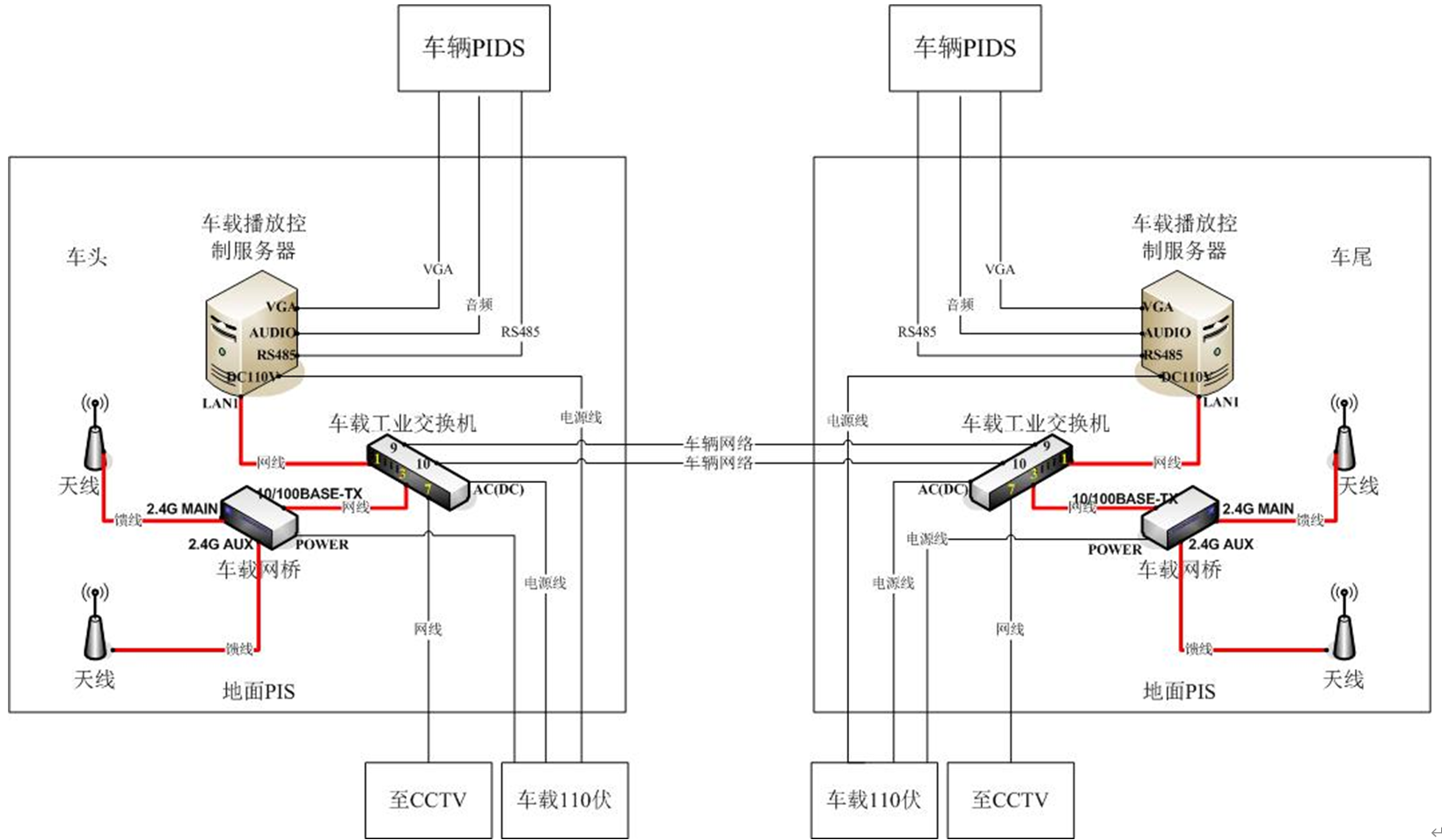
The project covers a total of 70 trains. The equipment to be upgraded includes onboard industrial switches, onboard bridges and antennas. The existing structure is illustrated below: currently, each train is equipped with one onboard playback control server and two antennas in the cab, with one onboard bridge and one onboard industrial switch installed in the passenger compartments adjacent to the cabs. These devices together form the onboard network for the ground‑based PIS.
Scope of the upgrade: the onboard playback control servers in the cabs remain unchanged; the existing two antennas are replaced by a single antenna (positioned at the right‑side antenna point in the existing cab); one onboard bridge and one onboard industrial switch are replaced in Passenger Compartment 1 and Passenger Compartment 6 (adjacent to the cabs), with an additional onboard industrial switch added on the far side away from the cab; and one onboard industrial switch is added in Passenger Compartment 3 and Passenger Compartment 4. These devices together constitute the onboard network of the ground‑based PIS.
02 Network Structure After the Change
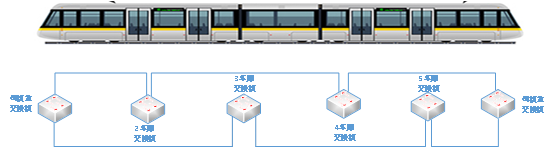
The onboard PIS adopts a ring‑network architecture to carry the digital onboard information display system. The ring network runs through the entire train and features redundant self‑healing switchover functionality. The onboard industrial switches in the cab and passenger compartments are interconnected via Gigabit M12 interfaces, forming a Gigabit ring network. Depending on the train consist length of each line, the network topology is as follows: the ring network ensures that a cable break does not affect the system, and guarantees that a failure of any terminal controller affects only its own carriage, with no impact on devices in other carriages – completely eliminating the drawbacks of the traditional cascade design.
This project selected MRD TCC4100 onboard industrial switches. The ring network formed by MRD industrial switches supports up to 50 nodes, far exceeding the typical 6‑ or 8‑car consists commonly used in metro trains. The self‑healing switchover time due to cable or controller failure is less than 50 ms, causing virtually no impact on services. A break in any transmission medium on the ring triggers the self‑healing mechanism without causing transmission interruption. The short self‑healing time (within 50 ms or less) has minimal impact on data transmission. VRRP (Virtual Router Redundancy Protocol) can be enabled on the two switches at the front and rear cabs to provide active‑standby redundancy.
For this project, the cab switches and carriage switches are MRD TCC4100 onboard industrial switches, powered by industrial redundant isolated power supplies (110 VDC / 220 VAC). Connections between the onboard switches and various service devices are made via M12 ports or twisted‑pair cables.
MRD Industrial Switch

TCC4100 Onboard Industrial Switch
·High‑performance and flexibly configurable switch
·Backplane bandwidth up to 68 Gbps
·Supports up to 8 PoE ports
·Supports PoE power supply, compliant with IEEE 802.3af and 802.3at standards
·Maximum PoE port output power: 30 W
·PoE management: PoE device detection, PoE power management
·Supports Ethernet ring network functionality based on MRD‑Ring® technology, with multiple self‑healing rings; node self‑healing time < 5 ms, ring self‑healing time < 50 ms (typical value)
·Supports MRD ring media redundancy protocol based on IEC 62439
·Supports BYPASS power‑loss bypass function for enhanced network reliability
·Any two ports can be used to form a self‑healing ring, with support for multiple independent self‑healing rings
·Dying Gasp function for active reporting of power‑loss status via SNMP
·Redundant dual‑power input design
·Built‑in MicOS real‑time operating system, unified across all MRD™ switches
·IP54/IP67 enclosure protection for stable operation in harsh environments
·Fanless, operating temperature –40°C to +85°C
·MTBF ≥ 600,000 hours
The onboard PIS upgrade project for existing Chengdu Metro lines is a typical large‑scale, high‑standard, and tight‑schedule metro retrofit project. MRD, with its solid product performance and complete onboard solutions, ensured the successful delivery of the project. As a leading domestic industrial communication enterprise, Shanghai MRDCom Co., Ltd. has always remained committed to an independently controllable technology path, deeply cultivating rail transit vertical scenarios. From onboard PIS to signaling systems, from AFC to integrated supervisory control, MRD has consistently provided reliable communication support for multiple metro lines. The successful implementation of this Chengdu Metro project once again confirms the capability and commitment of domestic industrial switches in replacing imports in critical rail transit systems. Shanghai MRDCom Co., Ltd. will continue to uphold benchmark‑class quality standards, contributing trustworthy Chinese communication power to the high‑quality development of urban rail transit.
MRD Showcases TSN Switches at 2026 CIIF
How Does a 6.8 km Yangtze River Crossing Tunnel Achieve Zero Communication Interruption?
MRD Industrial Switches in Xinjiang Kalpin 400MW CSP Project
MRD Patriot All‑Domestic Series with Changzheng Software Powers Nanhui Branch Line
Hotline: 86-21-58330762
Zip: 201203
Email: sales@mrdcom.net
Address: No.123 Curie Road, China (Shanghai) Pilot Free Trade Zone




Copyright 2026 MRD Co LTD . All Rights Reserved Shanghai ICP No.12035199


